Tuesday, October 14, 2014

Cover Reveal: Fairly Twisted Tales for a Horribly Ever After

Last November, I heard about a Project Runway-themed short story competition by REUTs Publications that coincided with National Novel Writing Month (NaNoWriMo). I'm not sure I'll ever have the discipline to participate in the full version of NaNoWriMo which involves writing 50,000 words in one month, but writing a short story in a week sounded like fun!

And it was fun! The theme of the competition was twisted fairytales with supernatural elements which led to lots of ghoulish entries, many of which were revealed later on the REUTs blog. I feel incredibly honored and excited that my entry, "Sweetheart Ronin," a reimaging of the Grimm Brothers' "Sweetheart Roland" was picked to be part of the final anthology.

Without further ado, here is the creeptastic cover of Fairly Twisted Tales for a Horribly Ever After...

.
.
.
.
.
.
.
.
.
.
.
.
.
Ta da!


Blurb: When it comes to fairy tales, there are plenty of things that go bump in the night. Things so morbid and grotesque, so sinister and diabolical, they haunt your imagination; warnings from generations past that still manage to terrify.

In 2013, authors came together for the annual Project REUTSway writing competition, penning their own interpretive twists on stories we're all familiar with. Seventeen were chosen, bringing twenty-five new versions to life. From The Brother's Grimm, to Hans Christian Andersen and beyond, these tales are not the ones you grew up with. They are, however, Fairly Twisted Tales for a Horribly Ever After. Dare to find out what happens when "once upon a time" ends in the stuff of nightmares?


Add To GoodReads - Follow On Twitter

I love the cover! The spooky background photo and color palate are perfect for a Halloween night read.

The other cool thing about the book is that some of the proceeds are going to charity. The 2013 organization was Reading Tree/Discover Books, a “green” charity which promotes literacy in the US by keeping books out of landfills, funding library sustainability, providing books to low-income families, and more.

For the 2014 season, Project REUTsway giving you the chance to decide where proceeds will go! The new year also brings with it a new theme. So brush up on your histories, legends, and cultural lore, because they'll be looking for the most original, fantastic versions of tales that have braved the centuries.


Wednesday, October 8, 2014

Of a Post about Post-Its

An Ode to Post-It Notes

O Post-It Notes, you keep me on track.
When my life gets out of whack.

When I get stuck or in a jam,
Your neon yellow says,"Here I am!"

You keep my thoughts and jots and scribbles
And all my unintelligible drivel.

My lists are safe when in your care,
You're sticky, so you'll stay right there.

My pad is gone, what will I do?
I'll get online and order two.

Tuesday, September 23, 2014

Of Myers-Briggs and Characters

In a previous blog post, I talked about getting to know your characters through their zodiac signs. While that was fun, it's not exactly scientific. And as I continue writing the main character of my latest novel, I want to make sure that she is believable and well-rounded.

At my day job, I've been working on a book about skills for business managers. One of the tools the book suggests is taking the Myers-Briggs personality test and learning about your strengths and weaknesses. But isn't that what we need to know about our fictional characters, too? I decided to take the test as my main character, Emily, and see what happened.

The test is based on Carl Jung's theories of how we experience the world. The test measures four different categories and assigns letters corresponding to which end of the spectrum you lean towards in each category. If you want to read more about the Myers Briggs test and personality types, visit the official website.

http://getcontrolofyourlife.org/2014/08/21/myers-briggs-2/

The actual Myers-Briggs Type Indicator test is 93 questions long and costs money to take. However, there are free online questionnaires that mimic the original test and will tell you which of 16 personality types you belong to based on your answers. A free version by Humanmetrics is here. And another one by 16 Personalities is here.

The Humanmetrics test is fast and easy to take. The 16 Personalities test takes a little bit longer, but it might make you think about your character's actions more because it asks you to choose on a sliding scale.

I filled out both versions as Emily and got very similar results, which I am taking as a sign that I have a good handle on her personality. On the Humanmetrics test, the result was ESFP. On the 16 Personalities test, the result was ENFP.


Both of these personality types describe someone who is fun-loving, sociable, curious, talkative, and emotional. Exactly what I was going for! But maybe that was a self-fulfilling expectation. I did fill out the quiz, after all.

However, I think the most helpful part of the results is discovering what you weren't expecting to see. Examining your character's personality profile for traits that may surprise you will give you a deeper understanding of how your character will react to the events in your story.

For example, if your character is highly introverted and is in a situation where he must be around family or friends for a long time, he would probably become stressed and seek to be alone. Or if your character is very intuitive and feels others' emotional pain keenly, how would she deal with those feelings?

On the flip side, if you want your character to display certain traits that did not show up in your character's type, find the type that does display those traits. What actions or emotions would your character need to display in order for them to be that type?

Another helpful exercise is to search for fictional characters in literature and film who share your character's personality type. By reading and seeing other characters with the same personality type, you may get some fresh insight into your own character.

So what is your character's personality type? Is it similar to or different from your own? Did you learn anything new after taking the test?

Monday, September 15, 2014

Under the Sealing Wax: The Alchemist Empress


One of the coolest things about the Middle Ages is that alchemy was a legitimate profession. Before the discovery of gravity, or the atom, or cells, there were men and women who searched for the secret to unlocking the mysteries of matter.

One such woman was Barbara of Cilla (1392-1451), wife of Holy Roman Emperor Sigismund. Renowned for her beauty and intelligence, she ruled over her husband's growing empire while he was away fighting wars and crusades. After his death, political rivals stripped her of much of her wealth, briefly imprisoned her, and accused her of heresy and immoral behavior. She was also rumored to have taken up the practice of alchemy later in life.

She was very rich, very clever, smart, educated and beautiful.
Queen Barbara at Mass. Starnberg - Konstanz. Fol. 21r

John of Laz, an "honest" alchemist, wrote an account of meeting Barbara that was quoted in several later alchemical treatises:
I heard the rumor in various languages about the queen of the king of divine memory, Sigismund, that she was skilled in the art of physics. I went to her to make an assessment of her in the art of physics, and she answered me cleverly. I saw that she took mercury and arsenic and other things she knew well, and she made a powder, which whitened the copper, but did not pass well the test with the hammer, and with that she made many deceptions among the people. [...] Again I saw, that she took some saffron of Mars [iron oxide], some saffron of Venus [calcified copper], and other powders, and mixed them, and made cement out of them, and grasped it together with pieces of gold and argent [silver], and united them, it appeared pure gold both from outside and inside. And when she cast the whole thing, it lost its red color, and thus many traders were deceived with that.
 When John tries to point out her trickery, she goes a little Red Queen on him:
I saw many tricks and deceptions carried out by her, and corrected her in words. She however wanted to jail me, but I could leave with peace, because God helped me.
(Translated by Benedek Lang in Unlocked Books: Manuscripts of Learned Magic, p. 156.) 
We can pretty safely assume that Barbara never unlocked the secret formula for turning lead into gold. She probably never found the key to eternal life, either, because she died of the plague in her late fifties.

CELJSKA Barbara
Barbara de Celje. Woodcut from the Nuremberg Chronicle.
However, during her marriage to Sigismund, Barbara helped to found the chivalric Order of the Dragon. Guess who was a member of the Order of the Dragon? ... Anyone? Anyone? Bueller?... Vlad Dracul, father of Vlad the Impaler, who is also known as Dracula! Coincidence? Perhaps not.


Saturday, September 13, 2014

Of Advice for a Quarter-Life Crisis


Last Thursday, I found myself in a room packed full of twenty- and thirty-somethings looking for guidance and direction in their lives because they were going through a quarter-life crisis.

A month or two ago, I wouldn't have felt the need to be in that room. I thought I had figured out my life five years ago when I decided to go to grad school, move up in my career, and get serious about writing. But, as so often happens, right when I thought my life was headed in the right direction, it all changed. In the span of two weeks, my brother and his wife moved 600 miles away, my writing career stalled, my manager gave his two weeks' notice at work, and another relationship ended. I felt like I had been trundling along the right path, when all of sudden, I hit a brick wall. The feeling of fulfillment I had in my work and personal life completely vanished, replaced by uncertainty and disappointment. So when a friend invited me to attend a four-week series on dealing with your quarter-life crisis, I immediately said yes.

Did I mention that my brother took this adorable creature with him, too?


Now, back to the room packed full of sad, lost souls with first-world problems. We all nodded along as the speaker talked about being overwhelmed with choices and feeling like we weren't far enough along in life. We all wanted answers, checklists, affirmation, a sign from God, a lifeline, anything that would reassure us that we would find our way eventually. We did get some guidance, and I want to share the advice that we got that night because it's simple, yet powerful. In fact, it is pretty much the same advice that you'd give to someone who was planning a trip:

1. Pick a destination. There are no right or wrong choices.
2. Aim in the direction of your goal -- direction, not intention, determines destination.
3. Avoid internal and external distractions along the way.
4. Enjoy the journey!

What I learned that night has already helped me immensely, especially the last point about enjoying the journey. There is so much in my life to be thankful for, that I don't want to let my setbacks get me down. It was also comforting to see that I wasn't the only one going through the feelings of loneliness, confusion, and frustration. If you're going through something similar, remember that you're not alone!

Every day is a journey, and the journey itself is home. - Matsuo Basho

As for me, I'm calling the cops on my pity party. There are still two more sessions in the series, but I am already feeling a thousand times better. I'm going to my very first writing conference next week, I've got new writing goals, I cleaned out my closet, and I'm enjoying spending time with the family and friends who have stayed close. Oh, and I finally bought a new refrigerator with a functioning icemaker so that when life gives me lemons, I can make frozen lemonade!


Wednesday, September 3, 2014

Of Why I Hate Making Ebooks


Because I work with ebooks as part of my day job as an editor at a business/academic publisher, I find the subject of ebooks to be particularly interesting. In theory, ebooks have a lot of advantages for consumers. I own a kindle and love its convenience for traveling. That's where the love stops. As an editor who is forced to produce ebooks, I find the making of them to be loathsome.

If you love ebooks, you probably want to stop reading this post now. They sell well, are great for authors, and are the wave of the future, blah blah blah. I get it and I don't care. If you want to hear why ebooks are the worst, then read on.

There has already been a lot written on why ebooks are bad for readers:
Ebooks are also obnoxious for the invisible cogs in the wheel: the editors, compositors, printers, and other behind-the-scenes people in publishing who make them or have lost business because of them.


typewriter throwing

First of all, I don't know many people who decided to work for a publisher because they were really excited about making books that you can double tap. We love books, which is why we work with books.

The external trappings of a book are just as important as the content on the inside. A lot of thought has gone into the size, shape, font, headings, cover art, etc. Ebooks obliterate all individuality of a book in favor of what the e-reader can support. We all know ebooks are ugly but it goes beyond that. Some e-readers can't display lists correctly or show emphasis through different font sizes, bolding, etc. As an editor, this is annoying because I have to shape the content to the demands of the e-reader, even though I believe the content should reign supreme. I work in business/academic publishing so it's doubly awful. Things like checklists, tables, boxes, and forms look terrible in ebooks and I feel bad for passing those on to a reader, but I can only work in the confines of the technology platform I'm given.

Also, different e-readers take different file types and things display differently on each platform. Smaller publishers often don't have the time, money, manpower, or expertise to make multiple .this or .that so they are forced to pick one and miss out on potential business because some customers decided to buy a Nook instead of an iPad.

animated rampage

Ebook production also disrupts the normal flow of the traditional publishing process, leading to errors. I hate errors. Lots of corrections and changes are usually made during the pageproofs stage of a book because (see list above) it's easier to read on paper than on screen. However, because it's faster to produce an ebook than a print book, those corrections are not captured in the ebook file, causing either mistakes or redundancy and inefficiency in the workflow. Maybe other publishers have figured this out, but I don't think so, given the number of errors I've seen and heard about.

Finally, it's frustrating to hear people complain that ebook pricing in the academic market is too high. Basically, the only cost that differs from ebook to print (in my company) is printing costs. Often, that's less than $5 per book, but many customers expect huge discounts in prices. The book still has to be edited, composed, and go through quality control. And if it's being sold by an online distributor, they take an extra cut. A self-published fiction book goes through a completely different process, so an author can still make a profit selling a book for $1.99. If my company sold first edition books for that price, I'd be out of a job.

So next time you get into a heated debate about ebooks (which I'm sure happens all the time), feel free to use these gripes as ammunition for why ebooks are the worst. Clearly, ebooks are here to stay but they have a long way to go in the academic market especially. I'm sure my grandchildren will read this one day on their e-readers on Mars and be amazed at how we ever survived with such primitive technology. Hey grandkids, don't forget to call me on my birthday.

Wednesday, August 6, 2014

Of Baking Cakes and Trunking Novels

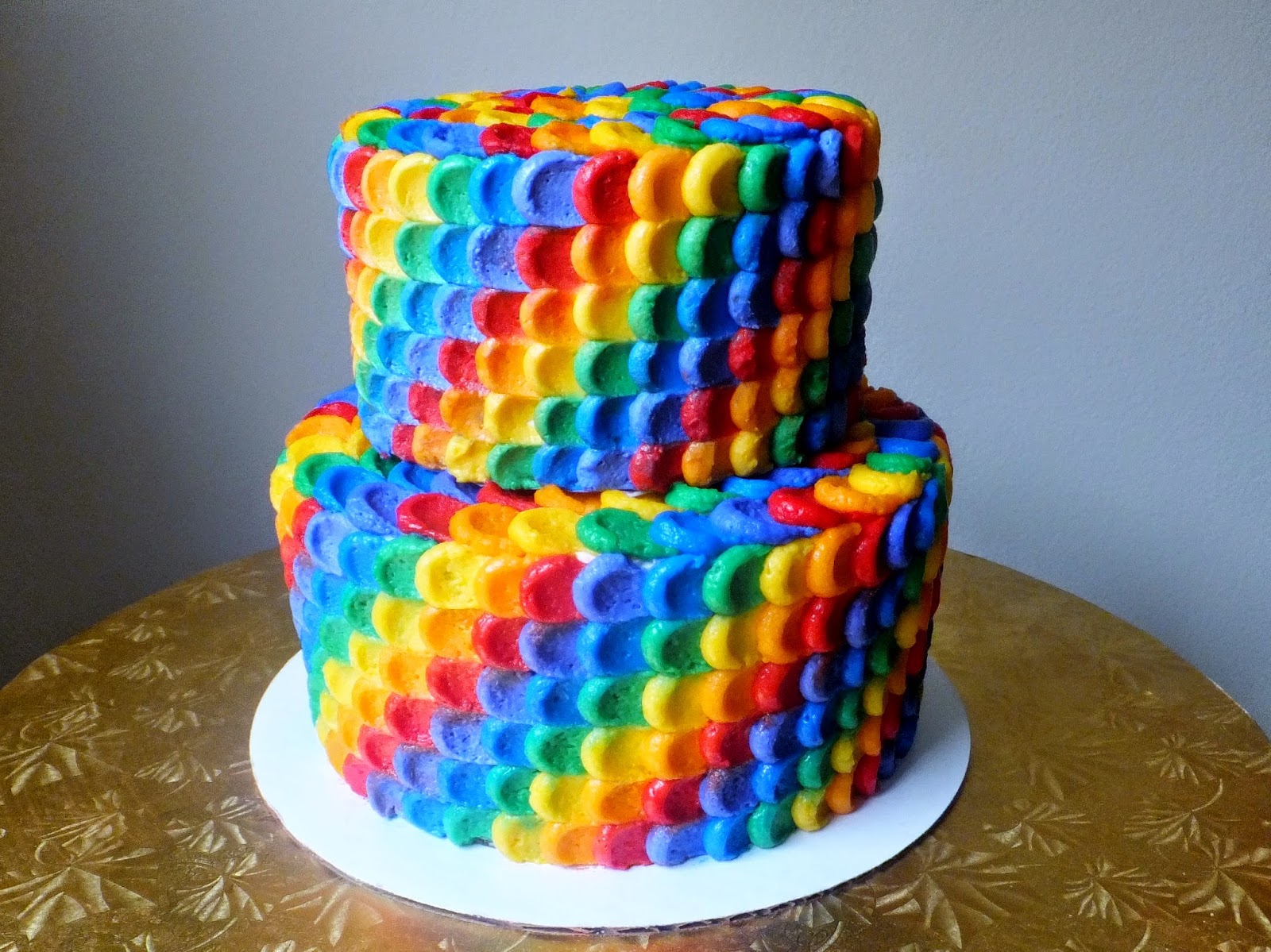
Last night, I tried to bake a rainbow cake for my co-worker's birthday. Why a rainbow cake? I don't know, but it seemed like a good idea at the time. My creative cooking muse is a fickle creature. I was hoping it would come out looking something like these beautiful confections:


Okay, well I knew it wouldn't look that good. But I wanted to make a bright, colorful cake.

I made my shopping list and went to the store after work. Armed with cake mix, food coloring, and cans of frosting, I was feeling confident. Later that night, I dove into baking. Everything was going great until I turned the pans upside down to remove the baked cake rounds. One broke completely, and the other one came out like this:


Still hopeful because I had another box of cake mix, I continued to prepare my cake. I even baked the second batch a little longer, thinking that would stop them from crumbling. Not so much. My rainbow cake was well on its way to becoming a rainbow disaster. 

But I had promised my friend a cake for her birthday...there was no turning back! I stacked my crumbling layers on top of each other with generous layers of frosting in between to hold them together. It looked absolutely awful. And I had gone through 75% of the two tubs of icing I bought. I shaved the edges and ended up with a plate full of neon crumbs that didn't look much better than the cake itself:

 
At that point, I decided to put the cake in the fridge to firm up and then deal with it later. This morning, I woke up and realized that even if I could only produce one slice of cake, my friend would still have something sweet to eat for her birthday. I used the remaining scoops of frosting to cover up one edge of the cake, cut it, and put the single slice in a tupperware. I even made it to work on time.


Mission accomplished and, according to my friend, her slice of cake tasted great. Whew!

My semi-failure brought to mind how it feels to keep working on a story or a novel that just isn't coming together. You know it's turning into a hot mess, but you've invested so much time and effort into it that moving ahead seems easier than abandoning it.

I recently put away a novel that I had been working on for a few months. After researching parallel universes, ondines, hair bleaching, and the physics of time travel, then falling in love with my characters, my manuscript was a hot, hot mess. Stepping away from it was hard, but I know it was the right thing to do. It freed up my time to start working on my next project, which is going much better.

Over the weekend, I started thinking about my trunked chapters again. With a few tweaks, I think I can keep the core of the story and start over with some modifications. Like my cake, there's a salvageable piece even if the rest of it has to go in the garbage.

So if you're struggling with your manuscript, listen to the voice that's telling you to walk away. Remember that there's no shame in putting it away in the refrigerator for a little while to firm up. I think some new authors keep forging ahead for too long and end up with thousands of words that they know aren't their best work. Knowing when to stop can be a good thing.

But at the end of the day, any time spent writing isn't wasted. It will help you get better and learn so that your next novel (or cake) is beautiful and holds together.